Why Senior IT Teams Should Attend the April 23rd AIT PizzaCast on Secure Remote Access
If you are responsible for remote access, user experience, network performance, or zero-trust strategy, you already know the problem: too many organizations are still being forced to choose between security and usability.
Traditional VPNs create bottlenecks, hairpin traffic, frustrate users, and keep IT teams stuck in a cycle of tickets, troubleshooting, and exception handling. At the same time, many SASE and ZTNA platforms promise modernization, but in practice they can introduce new layers of complexity, inconsistent performance, and hidden operational costs.
That is exactly why I’m excited to be joining All In Technology for their April 2026 PizzaCast:
Secure Remote Access Without Compromise: Performance, Zero Trust, and VPN Replacement with Cloudbrink
Thursday, April 23, 2026
11:30 AM MT / 12:30 PM CT
Virtual webinar
This session is built for IT leaders and senior technical staff who are tired of hearing theory and want practical guidance on what actually works in the real world.
Why this session matters now
Hybrid work is no longer a temporary condition. It is the operating model for many organizations, and that has exposed the limits of legacy VPN architecture. When users are distributed, apps live across SaaS, cloud, and private environments, and performance issues hit every layer of the connection, old remote access designs start to fail operationally and financially.
For senior IT staff, this is not just a user-experience issue. It becomes a leadership issue:
Security teams need stronger access control and better posture enforcement.
Infrastructure teams need to reduce latency, packet loss impact, and backhaul inefficiency.
Operations teams need fewer consoles, fewer moving parts, and fewer support tickets.
Finance and procurement teams need predictable licensing instead of feature-by-feature cost creep.
That is why this PizzaCast is worth your time. It is focused on the operational realities behind secure remote access modernization, not just the marketing language around VPN replacement.
Why senior IT professionals should attend
The practical value of this event is simple: you will leave with a clearer framework for evaluating whether your current VPN, SASE, or ZTNA approach is actually helping your environment or just masking deeper problems.
This session will resonate if your team is dealing with any of the following:
Your VPN is still “working,” but users keep complaining.
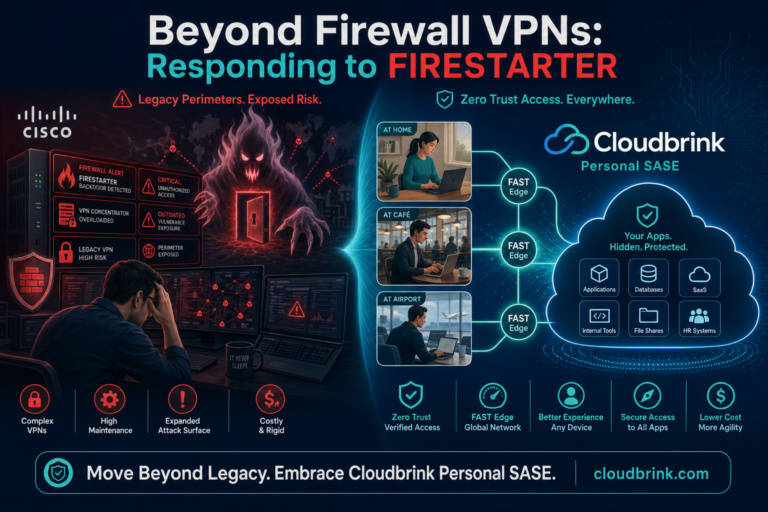
That usually means the architecture is no longer aligned with where your users and applications actually are. Legacy VPNs were not built for today’s hybrid workforce, especially when critical traffic still hairpins through centralized infrastructure.
Your SASE or ZTNA rollout improved policy, but hurt performance.
Many IT teams discover that “modern” access tools still introduce latency, fixed service edges, fragmented policy, or routing decisions that degrade the user experience. Cloudbrink was built to remove that tradeoff by combining high-performance ZTNA with personal SD-WAN and software-only deployment.
You need fewer tickets, not another architecture diagram.
One insurance organization that moved away from Fortinet and Cisco reported that support calls about remote connectivity had “pretty much disappeared.” In broader Cloudbrink materials, customers are described as reducing access-related incidents and even downsizing support overhead because the platform is software-based and centrally managed.
You are under pressure to simplify.
Cloudbrink uses a single named-user license with no add-on charges for edges, connectors, bandwidth, or features, and the platform is 100% software-only. That matters to senior IT teams because it reduces deployment friction, avoids hardware dependencies, and makes budgeting more predictable.
You need security that is stronger in practice, not just stronger on paper.
Cloudbrink’s architecture uses mutual TLS 1.3, rotates certificates every eight hours, and enforces access through identity, device posture, and policy in a unified model. For teams concerned about ongoing VPN exposure and long-lived credentials, that is a meaningful architectural shift.
What we’ll cover
According to the event page, the conversation will focus on both strategic and operational issues facing IT and security leaders today. Topics include:
- Why traditional VPN architectures create performance bottlenecks and security challenges
- How hybrid and distributed workforces have changed remote access requirements
- Where many zero-trust implementations fall short in real-world environments
- How Cloudbrink enables secure, high-performance access without legacy VPN limitations
- How modern secure access solutions can improve both user experience and security posture
- Practical considerations for organizations evaluating VPN replacement and zero-trust solutions
- How All In Technology fits secure access into a broader infrastructure and security strategy.
- That last point is important. This is not just a product conversation. It is a discussion about how to modernize secure remote access in a way that supports the larger operating model of the business.
What makes Cloudbrink different
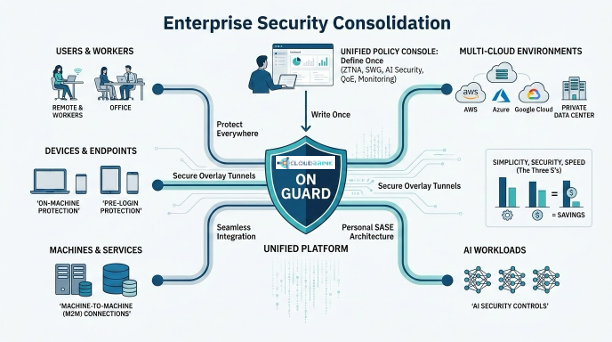
At Cloudbrink, we talk about three outcomes: Simplicity, Security, and Speed.
Simplicity: Cloudbrink is software-only, fast to deploy, and managed through a single console and unified policy engine. There are no hardware gateways to stage, no bandwidth licenses to untangle, and no fragmented stack to maintain.
Security: Cloudbrink delivers zero-trust access with mutual TLS 1.3, eight-hour certificate rotation, device posture checks, and secure access to private applications without exposing fixed infrastructure in the old model.
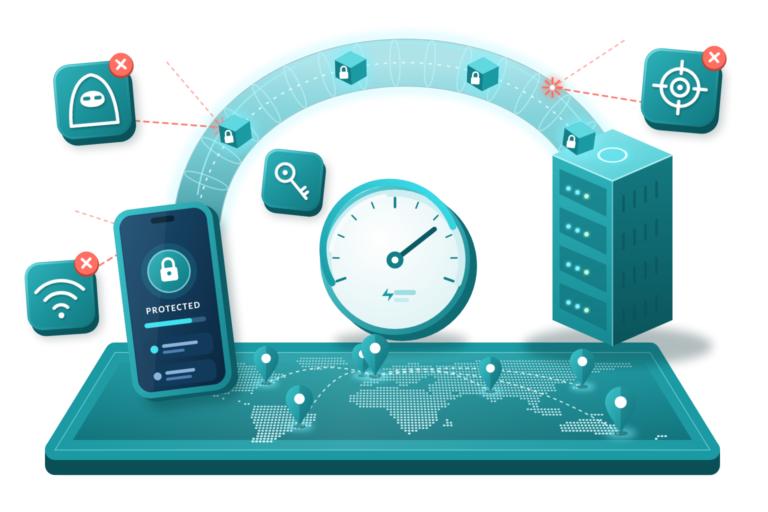
Speed: Cloudbrink’s FAST Edges are designed to stay close to users, with an average global proximity of about 5.2 ms, while the Brink Protocol dynamically mitigates packet loss and poor network conditions. In one developer use case, a Fortune 100 gaming developer reduced software artifact transfer times by over 30x and cut some connections from roughly 320 ms to as little as 5 ms.
For senior IT professionals, that combination matters because it changes the conversation from “How do we secure access?” to “How do we secure access without slowing down the business?”
Who should register
This session is especially relevant for:
IT directors and infrastructure leaders
Security and compliance decision-makers
Network and systems administrators
Teams evaluating VPN alternatives, ZTNA, or broader SASE strategies
Organizations supporting remote, hybrid, or globally distributed users.
If your users are complaining about slow applications, if your IT team is spending too much time chasing remote access issues, or if your security architecture still depends on compromises you no longer want to defend, this PizzaCast is for you.
Join us on April 23
This will be a live, interactive session, and qualified attendees who register by Tuesday, April 21, 2026 are eligible to receive complimentary pizza for the event. Registration stays open after that for webinar attendance, but the pizza offer closes two days before the session.
I hope you’ll join us.
Come ready with your VPN pain points, your SASE skepticism, and your toughest operational questions. We’ll talk about what is broken, what modern secure access should actually look like, and how to move forward without compromising user experience, security posture, or IT efficiency.
Register here: https://allintechnology.com/secure-remote-access-april-2026-pizzacast/