vpn vs ztna determines whether remote workers receive broad network access or tightly scoped application access. If you’re planning a VPN replacement or evaluating alternatives, this article breaks down the practical tradeoffs you need to weigh.
Key takeaways
Quick summary for decision makers: compare trust model, blast radius, performance and operational overhead when choosing an access model. Use these points as a checklist during a short pilot.
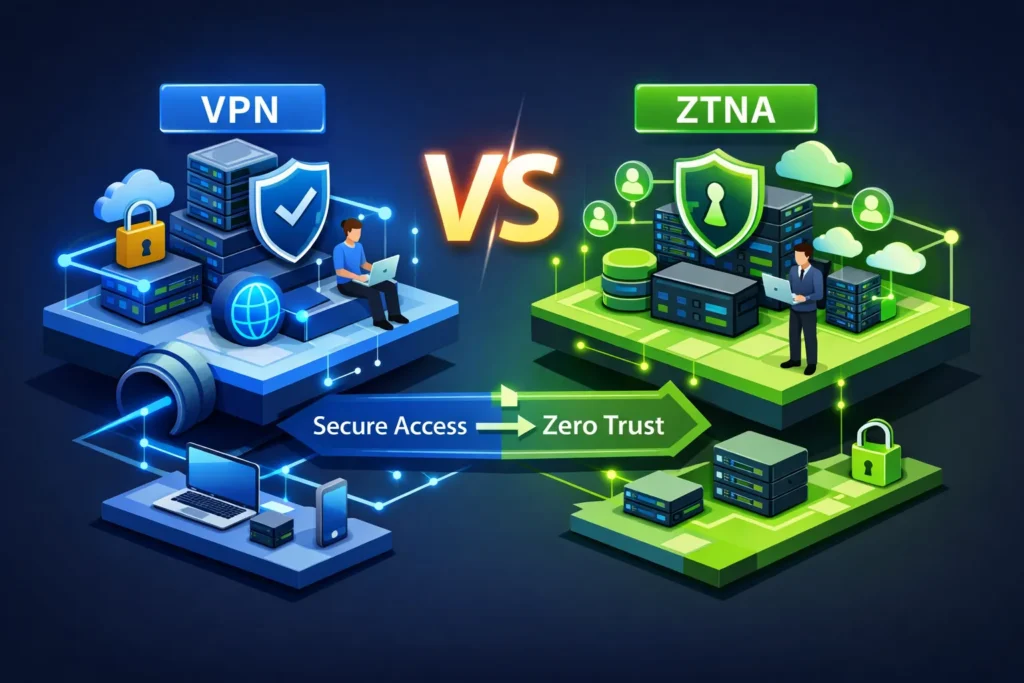
- Trust model matters: VPNs grant network-level access after one authentication, while ZTNA enforces per-request, identity- and posture-based access to specific applications to reduce persistent trust.
- Reduce blast radius: ZTNA’s proxy and software-defined perimeter hide services and enforce least privilege, limiting lateral movement compared with broad VPN tunnels.
- Improve performance: Distributed PoPs and proxied flows avoid backhaul, lowering latency and improving SaaS and CI/CD workflows.
- Lower operational cost: ZTNA shifts CapEx to subscription economics, simplifies scaling and typically reduces support overhead and refresh cycles.
- Migrate safely: Pilot with a representative cohort, inventory apps and flows, measure latency and support tickets, then phase rollout based on data.
Architecture and trust model: tunnel versus proxy
Understanding how each model places users on the network clarifies their risks and operational impact. Traditional VPNs create an encrypted tunnel that effectively puts the endpoint on the internal network after authentication, which often backhauls traffic to a concentrator and increases the attack surface. Once a VPN session is established, the user can reach many internal systems unless segmentation is in place, which raises opportunities for lateral movement and complicates access control. Managing those tunnels at scale also creates bottlenecks and predictable failure points.
ZTNA uses a broker or proxy to grant access to specific applications instead of the entire network. The proxy keeps services hidden from discovery until a policy explicitly allows a session, implementing a software-defined perimeter and simplifying compliance. Per-application access reduces the number of exposed services and narrows what attackers can see and target. Microsegmentation becomes easier when access is evaluated at the application level rather than the network level.
The architectural difference centers on separating control plane from data plane and distributing the data plane closer to users. VPNs typically centralize authentication and full-tunnel forwarding, creating backhaul bottlenecks and scaling challenges for distributed workforces. ZTNA keeps policy decisions in a cloud control plane and routes application traffic through regional points of presence, which reduces latency and simplifies policy enforcement. Cloudbrink’s ZTNA Technology Stack and Architecture implements this distributed data plane to avoid backhaul and improve performance for global teams.
Authentication also works differently: VPNs commonly trust once at connection time, while ZTNA evaluates each request in context. That per-request model checks identity, device posture, location and behavior continuously during a session, using signals like patch level, disk encryption and agent health. Continuous checks reduce persistent attack windows by ensuring policy follows the session rather than remaining fixed after an initial login. The result is tighter control over what a user can access at any moment.
Security comparison: threat surface, lateral movement and least privilege
Security is a core factor when comparing VPN and ZTNA. Traditional VPNs put users “on” the network after a single authentication and often grant access to many systems, so a compromised credential or exposed appliance can lead to broad internal exploration. Static tunnels and always-on routes turn one breach into many if segmentation is missing, and those environments can be slow to detect lateral movement. Attackers who gain network access face fewer immediate checks than in a per-request access model.
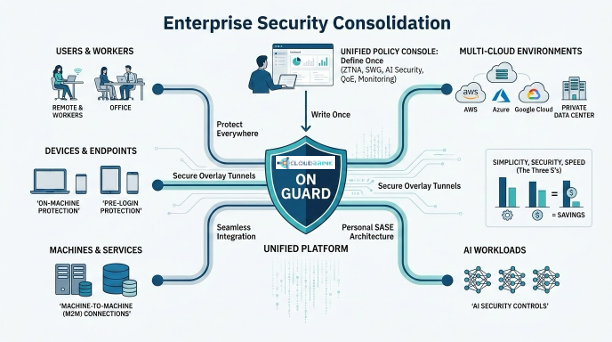
Proxy-based access limits discovery and reachability by enforcing per-application connectivity. With hidden services and dynamic, policy-driven access, users see only the apps they are allowed to use and cannot easily enumerate other hosts. Micro-segmentation at the access layer prevents lateral movement at the point of entry, and continuous device checks help block pivot attempts by default. For deeper context on how lateral movement plays out in modern cloud environments, see analyses of lateral movement risks in the cloud and how to prevent them. Cloudbrink Personal SASE combines certificate-free policy enforcement with session-level posture checks to provide least-privilege access without relying on network trust.
Visibility and response improve with per-session telemetry. VPN logs are often coarse and require correlation to map a user to a specific application, which slows detection and forensics. ZTNA delivers per-app session metadata and device posture signals that feed UEBA and SIEM tools directly, speeding investigations and reducing mean time to detect and respond. Richer logs make containment and follow-up actions faster and more precise.
Performance and user experience: latency, backhaul and real-world tradeoffs
Performance often determines whether a new access model is accepted by users. Centralized VPN concentrators and backhaul add hops and create throughput bottlenecks, which shows up as slow SaaS pages, choppy RDP sessions or stalled file transfers during peak hours. Those delays drive helpdesk volume and frustrate remote teams who need steady, low-latency connections for productivity. Measuring real user experience should be part of any evaluation.
ZTNA and a distributed SASE edge route users closer to the application instead of forcing a detour through a central gateway. That last-mile acceleration reduces round-trip time and cuts the number of congested links between user and service. For pilots, measure round-trip latency to key SaaS endpoints, page load times and file-transfer throughput to quantify improvements. Include scripted day-in-the-life tests that mirror developer and business workflows.
Gains in latency translate into measurable productivity wins: faster CI/CD operations for developers, quicker page loads for knowledge workers and fewer support tickets overall. Prioritize both network-level metrics and user-perceived performance when you grade pilot results. Cloudbrink’s global edge is designed to reduce last-mile delay and make those gains repeatable across regions. Capture both objective metrics and subjective feedback during the pilot to build a full picture.
VPNs still have a role for workflows that require IP-level connectivity, appliance management or strict isolation for regulatory reasons. During migration, coexistence patterns help you avoid disruption, for example phased cutovers and routing rules that keep critical paths on the legacy tunnel. Use unified agents that can support both models during the transition to simplify user experience and troubleshooting. Keep legacy tunnels only where required and plan their decommissioning once application-level access is validated. For examples of how organizations approach a staged move away from tunnels, review How Organizations are replacing VPN with Zero Trust.
Operations and cost: TCO, scaling and day-to-day management
Costs and operational effort often tip the decision toward one model. Traditional VPNs require upfront appliance CapEx, site-specific bandwidth and ongoing refresh cycles, while cloud-first ZTNA moves spending toward per-user subscription economics. Enterprise VPN concentrators and high-availability stacks can range from $50,000 to $250,000 per site plus roughly 18 to 25 percent annual maintenance, whereas cloud ZTNA subscriptions typically fall between $8 and $40 per user per month depending on features and support. Major TCO drivers are hardware, bandwidth backhaul and IT labor for patching and upgrades.
Operationally, VPNs need capacity planning, lifecycle management and site-specific configuration that scales with locations. ZTNA scales through the vendor’s cloud, which reduces hands-on maintenance, shortens onboarding time and moves control-plane updates off the ops team’s plate. Policy sprawl is a common source of helpdesk volume, and switching to identity-driven, per-application rules reduces support calls and privilege errors. Cloudbrink’s certificate-free policy model also cuts certificate churn and lowers routine support work.
For audits and compliance, ZTNA simplifies evidence collection with per-app audit trails, session metadata and fine-grained controls. You still need integrations for SIEM, long-term log retention and retention policies, and you should verify how continuous authentication and device posture checks appear in exported logs. During vendor evaluation, confirm support for session recording scope, SIEM integration limits and retention configuration. The list below helps you gather those details before committing to a migration plan.
- Confirm per-application access logs, session metadata export formats and retention options.
- Verify session recording availability and scope for privileged accounts.
- Validate SIEM integration, log throughput limits and cost model.
- Request documentation on continuous authentication, device posture signals and event replayability.
- Require a migration dual-run plan and clear rollback criteria for the initial cutover.
Operational clarity and shorter upgrade cycles typically reduce run-rate complexity and support costs. With those benefits in mind, use a migration playbook that minimizes user disruption and preserves auditability. The playbook below presents the practical steps to migrate without breaking access. Keep change windows short and monitor KPIs after each cohort stabilizes.
Migration playbook: how to move from VPN to ZTNA without breaking access
Follow these sequential steps to migrate safely while preserving access and minimizing disruption.
- Inventory and dependency mapping: Create a full inventory of applications, network flows and user groups by pulling data from VPN logs, proxies and identity providers. Tag apps that require IP-level access so you can prioritize special handling and build a least-privilege policy backlog.
- Pilot with a representative cohort: Run a short pilot while keeping the legacy VPN available as a fallback. Test SSO, device posture checks and continuous authentication, and capture metrics such as connection time, SaaS latency and helpdesk ticket volume. Iterate policies until the pilot reaches parity with legacy behavior for critical workflows and refine rollback criteria and support playbooks.
- Execute staged cutovers: Move cohorts in 7 to 14 day stabilization windows, define clear rollback triggers, validate app reachability and microsegmentation before decommissioning legacy paths, and remove orphaned VPN rules to prevent configuration drift.
- Monitor, tune and document: Track KPIs, tune policies and performance, collect user feedback, and keep stakeholders notified of phase results. Use automation and policy templates to reduce manual errors and accelerate rollouts.
- Finalize decommissioning and capture lessons learned: Retire legacy tunnels only when application-level access is validated, preserve audit trails for compliance, and document issues and playbooks so subsequent cohorts are smoother.
Choosing and validating a ZTNA solution (example: Cloudbrink Personal SASE)
Choose vendors based on technical capabilities that match your requirements and on pilot KPIs that reflect real work. Verify core features during a short proof of concept so you avoid reintroducing VPN-era risks in a modern architecture.
- Per-app proxy model: so users only reach specific applications, not the network.
- Continuous authentication and posture: device posture checks to enforce context per request.
- Distributed edge presence: global PoPs for low-latency routing and last-mile acceleration.
- SSO and MFA integration: unified identity flows and simpler operations.
- Rich telemetry and policy tooling: per-session telemetry and easy policy authoring to reduce support overhead and speed audits.
Pilot KPIs should tie to user outcomes so stakeholders can decide quickly. Track average connection time, SaaS and private-app latency relative to baseline, helpdesk ticket volume, policy count and time-to-onboard users; target an average connection time under two seconds and a noticeable drop in support tickets during the pilot period.
Validate with scripted day-in-the-life tests and focused red-team scenarios: run file-transfer and CI/CD workflows, RDP/SSH sessions and a simple breach simulation to confirm internal apps remain hidden and lateral movement is blocked. Grade results on a green/yellow/red scale and iterate until latency and error rates are acceptable, with rollback if core productivity KPIs turn red.
Cloudbrink Personal SASE addresses common VPN pitfalls with frictionless onboarding, certificate-free policies and a distributed edge that reduces latency and routine operations. In a pilot, developers authenticate and see only the Git or CI endpoints they need, device posture is checked per session, and telemetry records every session so stolen credentials do not automatically enable pivoting to other apps. Run a two- to four-week pilot focused on a mix of high-value SaaS and private apps, capture the KPIs above and present results to stakeholders to validate security and performance outcomes. Use the vendor’s migration dual-run plan and clear rollback criteria to keep the cutover predictable.
When making a final choice, weigh risk tolerance, application mix and performance needs rather than feature checklists alone. If reducing blast radius and enforcing least privilege are priorities, the per-application proxy approach will likely be the better fit. Retain limited VPN posture for a small set of legacy workflows that need full network access while migrating the rest. For a succinct checklist of what a modern ZTNA offering should include, see the six key characteristics of a modern ZTNA solution recommended by industry practitioners.
Choose the right path: VPN vs ZTNA for your team
Choosing between VPN and ZTNA comes down to trust model, blast radius and performance. VPNs place users on the network and increase the risk of lateral movement, while proxy-based ZTNA enforces least privilege, hides services and improves telemetry for faster detection. Balance those benefits against any legacy workflows that require IP-level access before you retire tunnels.
For broader strategic context on what comes after a ZTNA-first approach and which gaps to watch for, read Beyond the VPN: Why ZTNA Alone Isn’t Enough—and What’s Next.