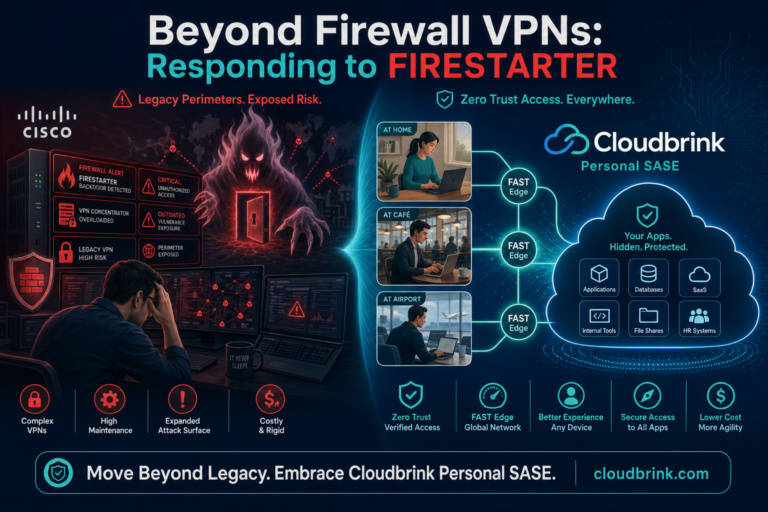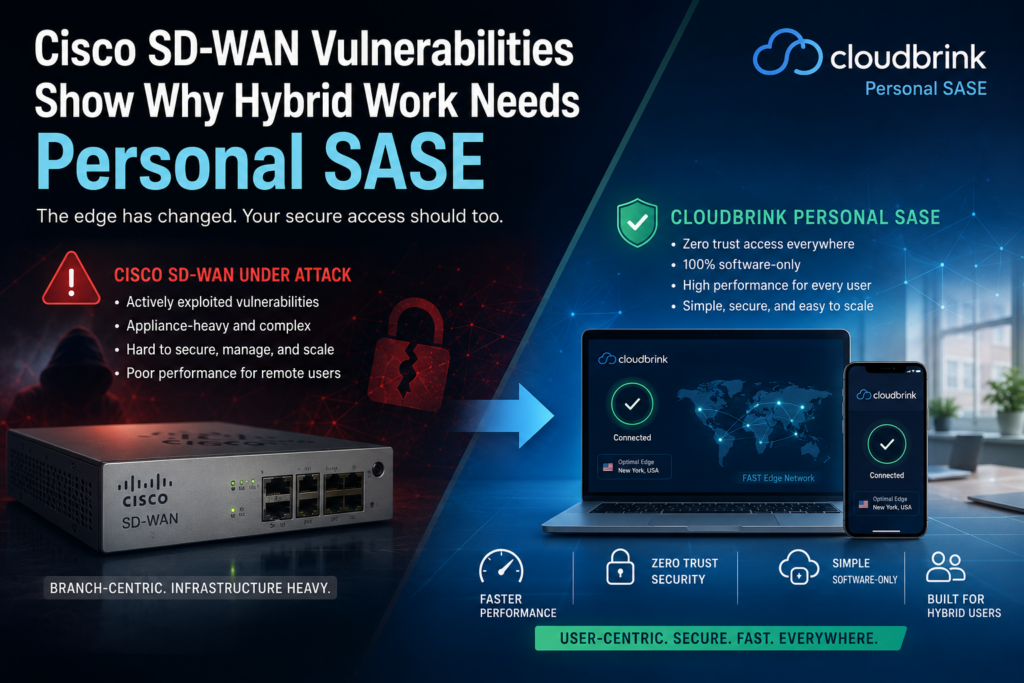
Cisco SD-WAN is back in the security spotlight.
A recent Cybersecurity Dive article reported a months long exploitation wave targeting Cisco SD-WAN systems, including Cisco Catalyst SD-WAN environments. The campaign raised broader concerns about trust, edge infrastructure, and the security of the network systems that enterprises and governments rely on every day.
But this is not just a Cisco issue.
It is a reminder that the enterprise edge has changed.
For years, the network edge was treated as a branch appliance, firewall, SD-WAN controller, VPN concentrator, or gateway. These systems were deployed, patched, monitored, and managed as trusted infrastructure. That model made sense when most users worked from offices and most applications lived in data centers.
Hybrid work changed that.
Today, the user is the edge. Work happens from home offices, hotels, airports, customer sites, coffee shops, studios, and shared networks; and of corporate course offices and branches. Applications are spread across SaaS, public cloud, private cloud, and on-premises environments. The old model of backhauling users through fixed infrastructure no longer matches how people actually work.
That is why Cisco SD-WAN vulnerabilities should trigger a larger conversation: not just “How fast can we patch?” but “Is traditional SD-WAN still the right architecture for secure, high-performance access in a hybrid-work world?”
What Happened With Cisco SD-WAN?
Cybersecurity Dive reported that researchers have been tracking attacks against Cisco SD-WAN since early 2026. The article describes activity involving Cisco Catalyst SD-WAN vulnerabilities, including authentication bypass, privilege escalation, and chained vulnerabilities affecting Cisco Catalyst SD-WAN Manager.
The article also highlights why SD-WAN and firewall management systems are such attractive targets. If attackers compromise infrastructure that controls routing, segmentation, policy, visibility, and administrative trust, they can potentially gain influence over a large part of the enterprise environment.
That is the uncomfortable truth about appliance-heavy secure access. The more trust an organization places in centralized infrastructure, the more valuable that infrastructure becomes to attackers.
Cisco is a major network infrastructure provider, so its products naturally attract attention from sophisticated threat actors. But the lesson applies broadly across traditional SD-WAN, VPN, firewall, and secure access architectures.
The edge is now a target. And the old edge was not built for the way people work today.
Traditional SD-WAN Was Built for Branches, Not People
SD-WAN has helped many organizations improve branch connectivity. It can simplify routing across locations, support multiple transports, and improve application paths between offices, data centers, and cloud environments.
But branch SD-WAN and hybrid-work access are different problems.
Traditional SD-WAN was designed primarily around sites. Cloudbrink was designed around users regardless of location.
That distinction matters.
Remote and hybrid users face performance problems that traditional branch SD-WAN does not fully solve: poor home Wi-Fi, congested broadband, packet loss, jitter, unpredictable ISP routing, hotel networks, airport networks, shared connections, and long paths to applications. These are location network, last-mile and mid-mile problems that show up directly in the user experience.
Since the location cannot be secured, a much higher level of security is built into personal SD-WAN using Dynamic invisible Networks, Automated Moving Target Defense with 8 hour rotating certificates, and higher levels of encryption and device posture analysis.
A branch appliance cannot fix every remote user’s home network. Shipping SD-WAN boxes to employees is expensive, complex, and hard to scale. It may help some users, but it does not address the real architectural shift: the enterprise access experience now has to follow the person, not the office.
That is why most companies can get better performance for users with Cloudbrink than with traditional SD-WAN.
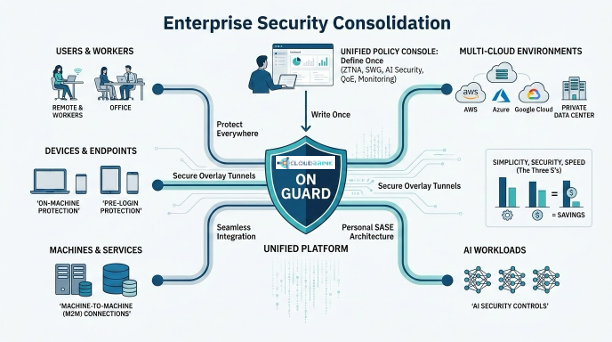
Cloudbrink’s Personal SASE is built to deliver high-performance zero-trust access directly to the individual user. It combines the Brink App, FAST Edges, the Brink Protocol, high-performance ZTNA, personal SD-WAN, Internet Security, and multi-cloud connectivity in a software-only service.
No branch appliance. No home router program. No hardware shipping cycle. No user left waiting for a box.
Cisco SD-WAN vs Cloudbrink: Branch SD-WAN vs Personal SD-WAN
Requirement | Traditional SD-WAN | Cloudbrink Personal SASE |
Primary design center | Branches and sites | Individual users regardless of location |
Deployment model | Appliances, controllers, gateways | 100% software-only |
Best fit | Site-to-site and branch connectivity | Secure access for hybrid and remote users |
Performance approach | Whole network routing optimization between known locations | Real-time zero-trust user-to-application optimization |
User experience | Depends heavily on local network quality and fixed paths | Designed to overcome packet loss, jitter, latency, and poor routing |
Security model | Infrastructure-centric implicit trust | Identity, device posture, location, and zero-trust policy |
Operational model | Hardware lifecycle, licensing, patching, and support | Single service, centralized policy, no user appliance |
Cost model | Often includes hardware, software, bandwidth, and operational costs | Single named-user model with no appliance rollout |
Traditional SD-WAN connects locations.
Cloudbrink’s personal SD-WAN improves secure connectivity for each user, wherever that user is working.
That is the difference between making the network better for offices and making work better for people.
Why Cloudbrink Delivers Better Performance for Users
Cloudbrink is built around a simple idea: secure access should not slow people down.
Most secure access products make a trade-off. They improve security but reduce performance. Users get more prompts, more latency, slower applications, and more frustration. IT teams then get more tickets.
Cloudbrink avoids that trade-off with a user-first architecture.
The Brink App runs on the user’s device and continuously monitors network conditions. FAST Edges provide close proximity to users without forcing IT teams to deploy or manage hardware. The Brink Protocol optimizes traffic in real time, helping overcome packet loss, jitter, latency, and unreliable paths.
The result is a secure access experience that feels much closer to working in the office.
A Global 500 media company saw this firsthand. The company had deployed SD-WAN appliances to thousands of remote workers who were struggling with performance. SD-WAN helped a little, but not enough as it did not provide preemptive and accelerated packet recovery on the locations network, and the hardware model was too expensive and difficult to manage. After deploying Cloudbrink, the company reported performance improvements of four to eight times on average with some users getting more than 30x on their file transfers. Almost all users returned their SD-WAN gateways immediately because they preferred Cloudbrink.
That is a powerful lesson for any company evaluating Cisco SD-WAN alternatives or SD-WAN replacement options for remote users.
If the problem is branch connectivity, traditional SD-WAN may still have a role.
If the problem is security and user productivity, Cloudbrink is the better fit.
Security Without the Performance Penalty
The Cisco SD-WAN campaign highlights why infrastructure-heavy access models create risk. Edge systems are attractive targets because they are trusted. They control access, routing, segmentation, and policy.
Cloudbrink takes a different approach.
Cloudbrink’s Personal SASE enforces zero-trust access using strong identity, device posture, policy, and encryption. It uses mutual TLS 1.3 and certificate rotation to secure communications. Access decisions can be based on who the user is, what device they are using, where they are connecting from, and whether the device meets security requirements.
Cloudbrink also delivers Dynamic Invisible Networks/Dark-Cloud secure access to all applications, helping reduce unnecessary exposure while still giving users the access they need to work.
This is the right model for hybrid work: least privilege, dynamic trust, strong security, and fast performance in one service.
Security should be invisible when everything is working correctly. It should not feel like a tax on productivity.
Simplicity: No Appliances, No Hardware Rollout, No Hidden Complexity
Cisco SD-WAN environments can be powerful, but traditional SD-WAN architectures often come with operational overhead: appliances, controllers, patches, licenses, hardware refreshes, gateway planning, and support cycles.
That complexity becomes harder to justify when the users are not sitting in branches.
Cloudbrink is software-only. Users install the Brink App. IT manages access and policy centrally. FAST Edges are dynamically available close to users. Connectors provide secure access to private applications in data centers, cloud, and multi-cloud environments.
There is no SD-WAN appliance to ship to every remote user.
There is no branch model to force onto the home office.
There is no need to choose between security and speed.
A national insurance company moved away from legacy VPN solutions, including Cisco and Fortinet environments, and deployed Cloudbrink quickly across hundreds of users. The result was faster access, a better user experience, and a major reduction in remote-connectivity support tickets.
That is what modern secure access should deliver: Simplicity, Security, and Speed.
The Business Case: Faster Users, Fewer Tickets, Lower Cost
The business impact of remote access is easy to underestimate until it breaks.
Slow access means developers wait on file transfers. Claims teams wait on core applications. Designers wait on creative assets. Sales teams struggle with collaboration tools. Support teams drown in tickets. Security teams rush to patch exposed infrastructure.
Cloudbrink changes the economics.
By replacing appliance-heavy remote access with software-only Personal SASE, companies can improve productivity and reduce operational cost at the same time. Users get faster access. IT gets fewer tickets. Security gets stronger control. Finance gets a simpler cost model.
Cloudbrink customers have reported dramatic gains, including up to 30x faster file transfers in demanding developer environments, major reductions in latency, and large improvements in remote worker experience.
The lesson is clear: performance is not a nice-to-have. It is part of security, productivity, and business continuity.
When secure access is slow, users look for workarounds.
When secure access is fast, users adopt it.
A Better Cisco SD-WAN Alternative for Hybrid Users
Organizations looking for a Cisco SD-WAN alternative should start by asking what problem they are trying to solve.
If the goal is to connect branches, traditional SD-WAN may still be part of the network strategy.
But if the goal is to secure and deliver and accelerated user expereince, Cloudbrink’s Personal SASE is a better answer.
Cloudbrink gives enterprises:
- Software-only deployment
- High-performance ZTNA
- Personal SD-WAN for individual users
- FAST Edges close to users
- The Brink Protocol for real-time optimization
- Secure access to private, SaaS, cloud, and multi-cloud applications
- Unified policy and visibility
- A simpler named-user licensing model
- Better remote-user performance than traditional SD-WAN in most hybrid-work environments
Cisco SD-WAN vulnerabilities are a reminder that the old edge is under pressure.
Cloudbrink is built for the new edge: the user.
The New Edge Needs Personal SASE
The enterprise edge is no longer a rack-mounted appliance in a branch office.
It is the employee working from anywhere.
That is why the next generation of secure access has to be personal, software-only, zero trust, and performance-first.
Traditional SD-WAN helped connect offices.
Cloudbrink helps people work.
For hybrid enterprises, that is the future: Simplicity, Security, and Speed — delivered to every user, everywhere.