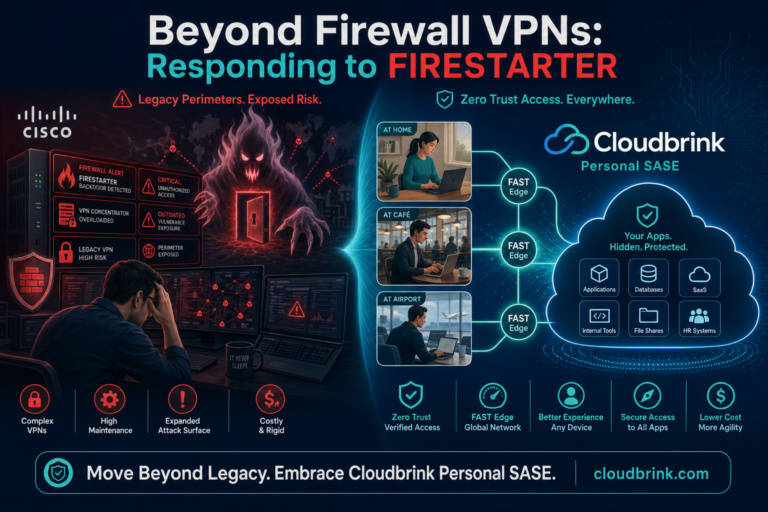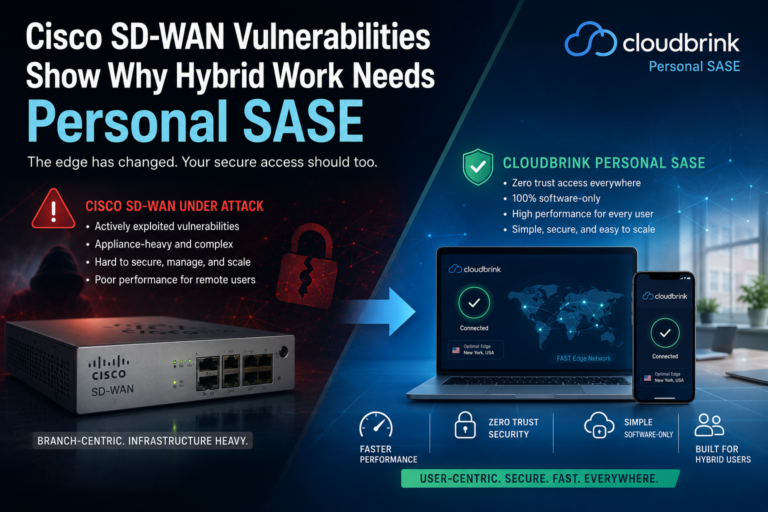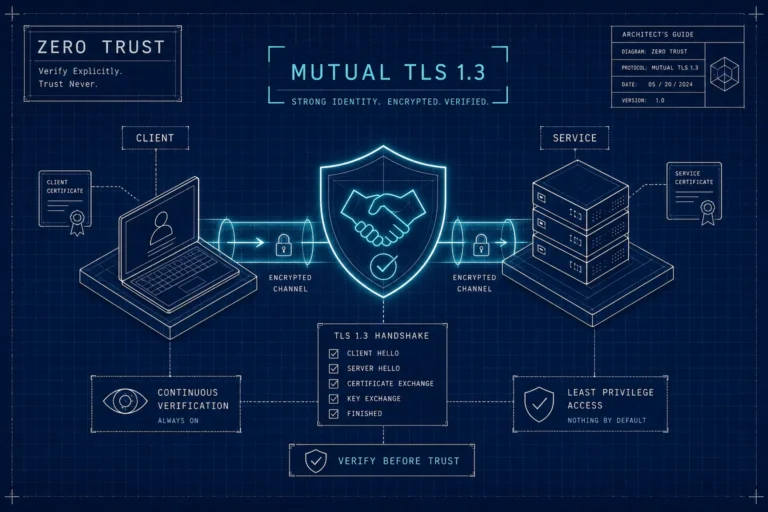
Enterprise security from companies like Cisco, PaloAlto Networks, Checkpoint etc. has a complexity problem – you don’t get Write Once, Protect Everywhere.
For years, the answer to every new security requirement has been remarkably similar: add another product – often from a company acquisition.
Need secure remote access? Add a VPN or ZTNA solution.
Need to protect internet traffic? Add a Secure Web Gateway.
Need better visibility? Add another monitoring platform.
Need to secure AI usage? Add an AI security product.
Each addition might address an individual requirement, but collectively they create something enterprises increasingly struggle to manage: more consoles, more licenses, more policies, more integrations and more operational overhead.
AI is now threatening to make that problem even bigger.
Cloudbrink™ believes there is a better approach.
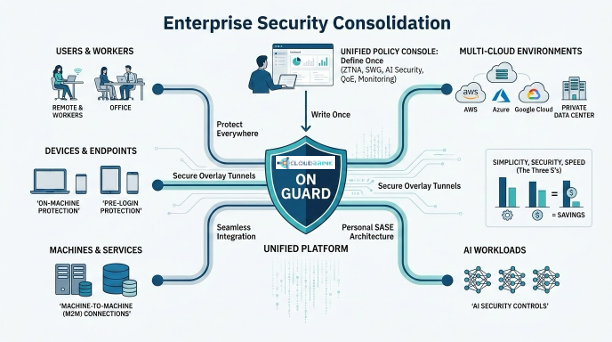
With Cloudbrink OnGuard, we are extending a single Cloudbrink security and connectivity policy across users, devices and machines. Instead of creating another security silo, enterprises can apply one policy framework across ZTNA, Internet Security, Secure Web Gateway capabilities, AI Security, Quality of Experience, multi-cloud connectivity and digital experience monitoring.
The principle is simple:
Write the policy once. Protect everywhere.
Security shouldn’t depend on someone logging in
Traditional remote-access security typically starts with the user.
A user authenticates, a session is established, and security policy is applied.
But today’s enterprise contains far more than interactive user sessions. Devices perform updates. Services communicate with applications. Machines connect to cloud resources. AI tools generate new patterns of traffic. Corporate endpoints may need protection before anyone has entered a username or password.
OnGuard changes where protection begins.
Cloudbrink OnGuard is a secure overlay tunnels that can operate independently of a user-context tunnel. That means connectivity and security policy can be available as soon as the machine comes online—even before a user logs in.
No user action is required to initiate protection.
Administrators remain in control, with the ability to authorize machine connectivity, terminate machine tunnels and determine which policies should apply.
That extends zero trust from being primarily about the person using a device to protecting the corporate asset itself.
Write Once, Protect Everywhere – One policy model for people and machines
The biggest benefit isn’t another checkbox on a security feature list.
It’s consolidation.
OnGuard allows administrators to apply multiple Cloudbrink capabilities to machine traffic from the same platform used to manage users, including:
- ZTNA access controls for private applications and resources
- Internet Security and Secure Web Gateway policies
- AI Security controls
- Cloudbrink Quality of Experience optimization
- Multi-cloud connectivity
- Digital experience and activity visibility
User and machine activity can also be viewed through a centralized management environment, allowing administrators to correlate activity and troubleshoot issues without jumping between disconnected systems.
This builds on Cloudbrink’s broader Personal SASE architecture, which already combines high-performance ZTNA, AI Security, personal SD-WAN, security and Quality of Experience in a 100% software-only service. Cloudbrink’s architecture is designed to provide unified security and networking policies rather than forcing IT teams to manage different policy definitions across loosely integrated products.
AI security shouldn’t become another silo
AI is creating a familiar enterprise security pattern.
A new technology emerges. New risks emerge with it. And the immediate industry response is to introduce another standalone product.
That may solve today’s problem while creating tomorrow’s operational headache.
AI workloads aren’t isolated from the rest of the enterprise. They involve the same users, devices, applications, internet destinations and cloud environments IT teams are already responsible for securing.
So why should AI security require an entirely separate operational model?
OnGuard is based on the opposite philosophy: extend the policy architecture you already have rather than creating another one.
It means organizations can bring AI security into the same framework they use for connectivity, internet access, application access and device protection.
That isn’t simply consolidation for consolidation’s sake.
Fewer independent policies can mean fewer opportunities for gaps, inconsistencies and configuration errors. Write Once, Protect Everywhere including AI.
A different approach to the multi-product security stack
Large networking and security vendors have spent years assembling portfolios containing separate technologies for VPN, secure access, internet security, networking and, increasingly, AI security.
Those products may share a vendor logo, but that doesn’t automatically make them one architecture.
The result can be separate technologies, policy models and operational workflows that IT teams must integrate and maintain.
Cloudbrink was built differently.
The objective is not to assemble a collection of products and call it a platform. It is to give enterprises one software platform through which security, connectivity and user experience can be managed together – Write Once, Protect Everywhere.
That philosophy is particularly important as infrastructure becomes increasingly distributed across SaaS, private applications, data centers and multiple clouds.
Cloudbrink’s Personal SASE service is software-only and combines the Brink App, FAST Edges, high-performance ZTNA, personal SD-WAN and the Brink Protocol to deliver secure connectivity while actively addressing latency, packet loss and other network impairments that reduce application performance.
In other words, consolidation shouldn’t force organizations to choose between security and speed.
They should get both.
Simplicity has measurable business value
Security architecture discussions can easily become debates about features. The more important question is what happens operationally once a technology is deployed.
One U.S. insurance company provides a useful example.
Before Cloudbrink, the organization operated Cisco AnyConnect and Fortinet remote-access technology. Its IT organization was dealing with performance limitations, management complexity and significant remote-connectivity support overhead.
After adopting Cloudbrink, the company transitioned approximately 300 employees on the first day and more than 600 during the first week.
More importantly, its VP of IT reported that remote-connectivity support calls had “pretty much disappeared.”
That outcome demonstrates why simplicity isn’t merely an administrative convenience.
Every policy that doesn’t need to be duplicated, every product that doesn’t need to be integrated and every support ticket that doesn’t need to be opened gives time back to IT—and gives employees time back to do their jobs.
The three S’s: Simplicity, Security and Speed
OnGuard expands a model Cloudbrink has been building around three principles.
Simplicity means one software platform, centralized visibility and a common policy architecture of Write Once, Protect Everywhere instead of an expanding collection of appliances, consoles and licenses.
Security means zero-trust controls can extend beyond individual user sessions to devices and machines, with policies based on the requirements of the enterprise.
Speed means security doesn’t have to come at the expense of application experience. Cloudbrink’s performance architecture is designed to overcome real-world network impairments and provide a LAN-like experience wherever people work.
Cloudbrink customers have already demonstrated what that performance difference can mean. In one Fortune 100 developer environment, software artifact transfers improved by more than 30x compared with the company’s VPN, while direct multipath routing reduced approximately 320ms connections to as little as 5ms for some developers.
The result of combining those three S’s is a fourth:
Savings.
Write Once, Protect Everywhere means: Less infrastructure. Less policy duplication. Fewer products to operate. Fewer support calls. And less employee time lost waiting for applications or troubleshooting connectivity.
The next generation of security should eliminate complexity, not add to it
The enterprise attack surface isn’t becoming simpler.
AI, cloud adoption, distributed applications, remote users and machine-to-machine connectivity will continue to create new requirements.
But that doesn’t mean enterprises should accept a corresponding increase in security products.
The better architecture is one that can extend as those requirements change.
That’s the idea behind OnGuard.
One platform. One policy framework. Users, devices and machines.
Write once.
Protect anywhere.