Cato Networks vs Zscaler
In modern IT environments, organizations need secure access that is not only safe, but also simple to operate and fast enough for real users. Both Cato Networks and Zscaler are established players, but they approach the market from different starting points.
The same but different
Cato is rooted in converged networking and security, while Zscaler is rooted in cloud-delivered zero trust and SSE. Cloudbrink is a strong alternative for organizations that want the benefits of zero trust and high performance networking without sacrificing user experience, cost, deployment simplicity, or application performance.
| Area | Cloudbrink | Cato Networks | Zscaler |
|---|---|---|---|
| Core Focus | High-performance secure access for remote + hybrid users Plus SAFE AI | Network centric security SASE platform combining networking, security, and access | Zero trust access and cloud security for users, apps, SaaS, and internet traffic |
| Architecture | Dynamic, software-only FAST Edges with personal SD-WAN and high-performance ZTNA | Global cloud-native SASE platform built around a private backbone and integrated PoPs | Cloud-native Zero Trust Exchange with large-scale distributed enforcement for internet, SaaS, and private app access |
| Primary Security Tools | Safe AI, ZTNA, Internet Security/SWG, AMTD, mutual TLS 1.3, identity and device posture enforcement | SSE, SWG, FWaaS, SD-WAN security, Universal ZTNA | ZPA, ZIA, SWG, CASB, DLP, segmentation, context-aware policy controls |
| Network Optimization | Significant optimizations, Advanced end-to-end acceleration for users and apps regardless of location or network quality | Limited to strong WAN and branch optimization with backbone-assisted transport and SD-WAN capabilities | Strong cloud security access, with performance benefits tied more to platform scale and traffic steering than to user-side acceleration |
| Ideal Use Case | Organizations that want Safe AI, simple deployment, strong security, and very fast remote/hybrid user experience not just office. | Enterprises modernizing office WAN, branch, and security infrastructure in one platform with few or no remote users on poor networks | Enterprises prioritizing mature zero trust, SSE, cloud security, and broad policy enforcement across users and applications |
What Type of Solution Are They
Cato Networks
Cato Networks positions its platform as a single-vendor, cloud-native SASE service that converges SD-WAN, security, remote access, and a global backbone. Its messaging centers on unified networking and security, centralized policy control, and gradual adoption across sites, users, applications, and clouds. Cato is commonly a fit for organizations focused on WAN transformation, branch connectivity, and broader SASE consolidation. It is weak when there are remote users on poor networks and there are complaints of WAN costs escalating quickly.
Zscaler
Zscaler centers its platform on the Zero Trust Exchange, with Zscaler Private Access (ZPA) serving as its ZTNA offer for private apps, workloads, and OT. Its strength is cloud-delivered zero trust access, broad cloud and SaaS integrations, and a mature SSE-oriented platform. In GigaOm’s 2025 ZTNA Radar, Zscaler is positioned as a Leader and Fast Mover in the Maturity/Platform Play quadrant. Primary complaints includes complexity, cost and poor performance.
Cloudbrink
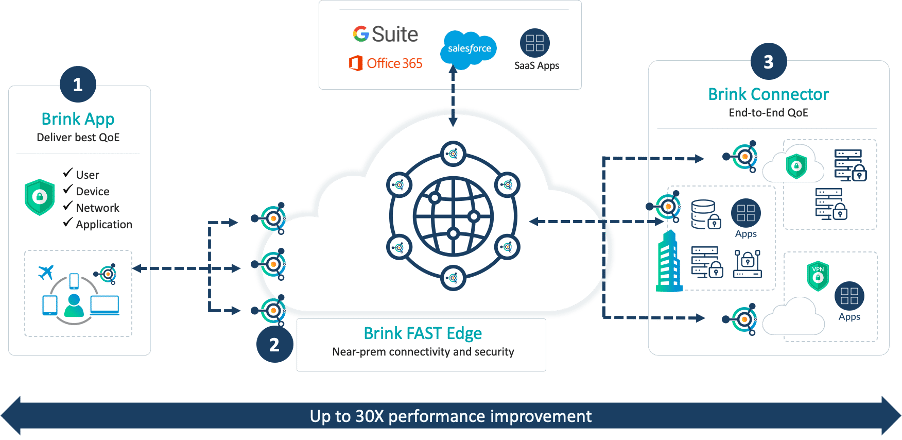
Cloudbrink’s Personal SASE is a software-only secure access platform built around the user experience. It combines Safe AI, high-performance ZTNA, personal SD-WAN, Internet Security, FAST Edges, the Brink App, and multi-cloud connectivity in a single service. Cloudbrink emphasizes the three outcomes enterprises care about most: simplicity, security, and speed. It is designed to give office, hybrid and remote workers LAN-like performance without hardware, fixed gateway management, or bandwidth licensing complexity. Cloudbrink was recognized in GigaOm’s 2025 ZTNA Radar as a Leader and Fast Mover in the Innovation/Platform Play quadrant.
Key Differences
Core focus
Cloudbrink: High-performance secure access for office, hybrid and remote users
Cato Networks: Converged SASE with strong SD-WAN and network-security roots for the office and branch
Zscaler: Cloud-delivered zero trust and SSE for users, apps, and data
Architecture
Cloudbrink: Dynamic, software-only FAST Edges close to users, with no hardware required
Cato Networks: Global cloud-native SASE platform with integrated networking and security
Zscaler: Large cloud security platform with the Zero Trust Exchange and ZPA for private access
Primary strength
Cloudbrink: Safe AI, End-user performance, deployment simplicity, and modern zero trust security
Cato Networks: Unified WAN and security modernization
Zscaler: Mature zero trust access and broad SSE/cloud security capabilities
Security approach
Cloudbrink: Left shift with central control. AMTD Mutual TLS 1.3, eight-hour certificate rotation, dynamic edges, identity and posture-aware policy, and Dark-Cloud access to private apps
Cato Networks: Context-aware access and unified policy inside a converged SASE platform
Zscaler: Context-aware zero trust access through ZPA and the broader Zero Trust Exchange
Operational model
Cloudbrink: Single named-user license with no add-ons for bandwidth, connectors, or visibility modules
Cato Networks: Platform-centric SASE adoption model – significant bandwidth fees
Zscaler: Core offerings plus add-ons and broader platform expansion options – complex licensing
Ideal use case
Cloudbrink: Organizations that want secure access and Safe AI to feel fast and frictionless for users anywhere
Cato Networks: Enterprises prioritizing branch, WAN, and full-platform SASE transformation
Zscaler: Enterprises prioritizing mature cloud security and zero trust controls across diverse environments
Why It Matters
Choosing between Cato Networks and Zscaler or Cloudbrink depends on what problem you are solving first. If your priority is converging networking and security with strong SD-WAN roots, Cato is a logical option. If your priority is a mature cloud security and ZTNA platform with broad integrations, Zscaler is a logical option.
But many organizations are not just looking for features. They are trying to eliminate remote access complaints, reduce support burden, improve application responsiveness, and simplify operations. That is where Cloudbrink stands out. Cloudbrink’s architecture is built around user experience as much as security, with software-only deployment, unified policy, and performance optimization designed for hybrid work.
A good example is a national insurance company that evaluated alternatives including Zscaler and Cato Networks, but found those options still required hairpinning traffic through data centers for some applications. After moving to Cloudbrink, it onboarded 300 employees on day one and more than 600 by the end of the first week, while remote-access support calls “pretty much disappeared.”
Cloudbrink also brings measurable performance advantages for demanding users. In one anonymized Fortune 100 developer environment, it reduced software artifact transfer times by over 30x compared to VPN, eliminated as much as 300 ms of latency for some users, and supports daily transfer rates up to 8 TB per user.
Which One Should You Choose?
Choose Cato Networks if your main goal is to modernize branch networking and security with a unified SASE platform.
Choose Zscaler if your top priority is mature cloud security, SSE capabilities, and broad zero trust access across a large ecosystem.
Choose Cloudbrink if you want zero trust access including Safe AI that is simpler to deploy, stronger for hybrid-user experience, and engineered to remove the traditional tradeoff between performance and security.
Ready to Experience a Better Alternative?
Cloudbrink Personal SASE helps organizations replace legacy VPNs and overcome the limitations of traditional ZTNA and SASE products with a software-only approach built for simplicity, security, and speed.
To avoid detection, modern attacks are “low and slow“. By rotating certificates multiple times a day, these exploits that involve certificates are eliminated
A Secure and Performant Remote Access Solution